Measure from the pillow
Before shopping for a bedside light, sit up in bed in the position you actually use to read. If you put a pillow behind your lower back or rest the book on your knees, do both. Hold a page at a comfortable angle and mark the height of its center with a piece of removable tape on the side of the nightstand or a nearby wall. Ask somebody else to mark eye height if they are there. Those two points matter more than the height of the mattress alone.
A reading lamp has two jobs in this position. It has to put enough light on the lower half of a page, and the bright part of the fixture has to stay out of your direct line of sight. The easiest place to begin is slightly behind the shoulder on the side where you are less likely to cast a shadow with your hand. If your side of the bed has a wide headboard, the edge of the board may force the light farther forward. Try the position with an existing lamp before assuming the shade you saw in a shop will cover that geometry.
Read one full page in the test position. Look down at the bottom corner and up at the top line. If you tend to lean into the beam before you have finished the page, the useful patch of light is too small or too far to one side. If the page looks bright but the print is difficult to follow, light may be bouncing from coated paper or a screen. Moving the light slightly to the side can fix that without lowering the output.
Test the view from the other pillow
A lamp can work perfectly on the reading side and still put a bright spot straight into the eyes of the person next to you. Turn off the other lights and sit on the other side of the bed with your head close to the pillow. Look toward the shade, then toward the wall across from it. A visible bulb or a hard oval on that wall may be enough to disturb somebody who is trying to sleep.
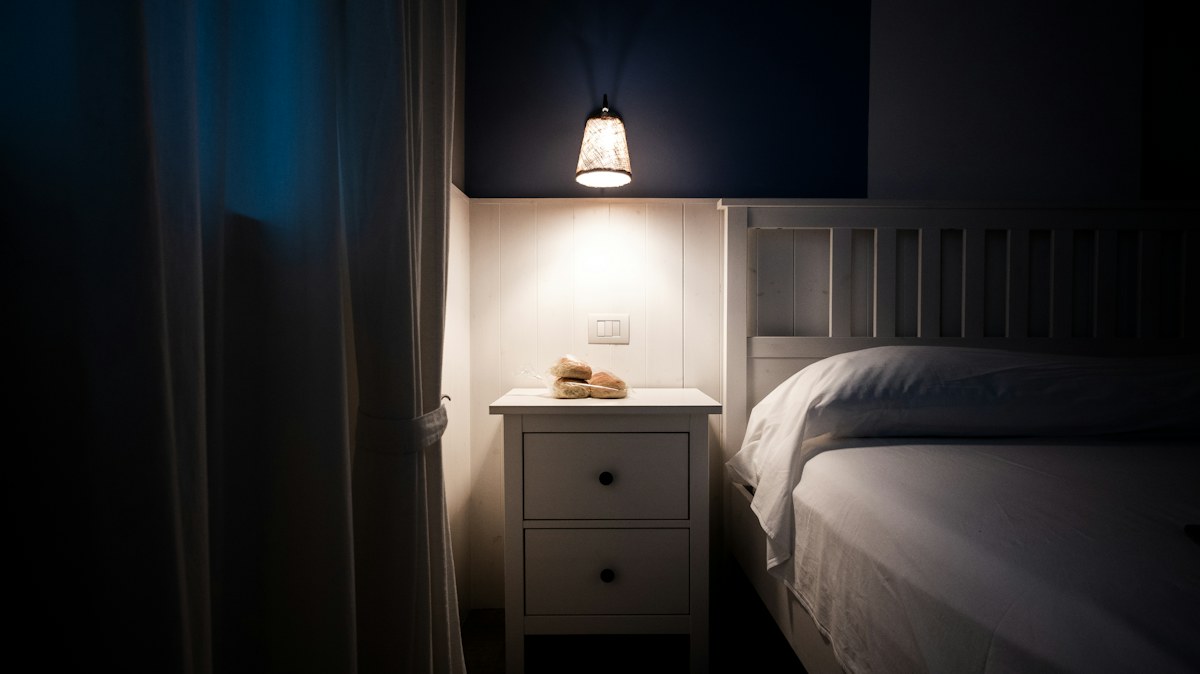
The shape of the shade determines where the light escapes. A lamp with a deep opaque shade sends more light in a specific direction. Tilt it toward the middle of the page, then turn it a few degrees toward the reader's shoulder to cut the spill. A white fabric shade can spread soft light through the room, which is pleasant while making the bed or finding a sweater. If you use it for reading while somebody sleeps, the glowing side of the shade may be a problem. A separate narrow beam on your side can give the ambient lamp a different purpose.
For a directional shade, check whether the source is recessed behind its lower edge. A small adjustment in angle can expose an LED that was hidden when the fixture pointed straight down. Look at it from the door, from the other pillow, and from a seated position at the edge of the bed. If the light passes all three views, you can use it without turning it back toward the wall every night.
Compare a table lamp and an adjustable fixture in place
A table lamp is straightforward to test because you can move the entire base. Try it at the back and at the front corner of the nightstand. At the back, the table stays available for a book and water. Closer to the front, the light reaches a page held forward more easily. A lamp that only works from the front corner may leave too little room to put down a drink safely.
An adjustable arm or angled head is useful if you change positions. Try sitting with the back pillow high, then moving it down and holding the page closer. A good arm can reach both with a small adjustment, and its hinges stay put when you take your hand away. Check how far the head extends when you are climbing into bed. A lamp that sticks out over the place you naturally sit down will be moved out of the way often, which makes it less practical as a reading light.
A plug-in wall light can free the nightstand if the table is very shallow. Before fixing anything to the wall, check that the cord can follow an unobstructed line to a suitable outlet and that the fixture can be installed according to the manufacturer's instructions. Where mounting is impractical, a freestanding lamp with a compact base or a stable base on the floor behind the table may do the same job. Keep cords out of the area where people walk, and avoid pinching them between the bed and wall.
Decide what should stay in reach
Make a short list of the things that genuinely live at the bedside. A book, glass of water, glasses, and phone often account for almost everything. Put these objects in their usual places and reach for each one in the dark. Put glasses where your hand finds them without crossing the glass of water. Give the book enough room to lie closed instead of sliding off the edge. Leave the switch where you can find it without reaching around a hot shade or fumbling behind the table.
If the lamp switch is on the cord, test where the cord hangs once the lamp is in position. An in-line switch can be easy to find when it rests beside the table, or impossible to locate when it slides behind the headboard. A control on the base or head is easier to remember by touch. A dimmer is useful only if you can operate it without looking directly into the light. Check that a replacement bulb is marked as compatible with the fixture and its dimmer.
A shelf or nightstand with a drawer does not automatically give more useful surface. It can let you move reading glasses and a charger off the top, but a drawer that opens into the side of the bed will become a nuisance. Try opening it while sitting down, with your feet in the place they usually land in the morning. Rearrange the table or choose a shallow open shelf if you would otherwise have to stand every time you retrieve the glasses.
Find a comfortable brightness after dark
Evaluate the light at night when the room is lit the way it usually is before bed. A lamp tested during daylight may look brighter simply because the window fills in the shadows. Read a matte paperback first, then any glossy magazine or tablet that you regularly use. A reflection that travels with the angle of the page is a cue to move the light sideways rather than changing every setting on the fixture.
If you have a dimmer, start at the middle and read for several minutes. Move up if the small type is hard to see without squinting. Move down if the page feels much brighter than everything around it and you keep looking away. The useful setting is the one you can keep for several pages without wanting to adjust your head or the book. Some lamps remember the last dimmer level after you switch them off. Try it twice if you want to know what will happen when you reach for it the next evening.
Warm light makes many pale walls look softer in a bedroom. It can also shift the appearance of blue ink, colored illustrations, and some fabrics. Use a bulb whose color you like on the actual page and the actual wall. If you use the same lamp to choose clothing in the morning, you may want a second light that helps you distinguish close colors. Keeping the reading lamp aimed at the bed lets it do its primary job well.
Try the finished setup for two nights
On the first night, place the book, glasses, and water in the positions you chose. Turn the lamp on and read without moving the table. When you put the book down, notice whether its natural landing place is the one you left clear. If your hand settles somewhere else, see whether the base can move slightly rather than asking yourself to remember a new habit every evening.
On the second night, change only the detail that bothered you. Move the head up a little if the beam cut off the last few lines of a page. Move the base back if you kept tapping it when you reached for a glass. If two people share the room, have the person on the other pillow check the change before you call it settled. A half turn of the shade may be enough to keep their side dim.
Write down the working height and how far the shade sits from the edge of the mattress if you are still shopping. Bring the approximate height of the nightstand as well. These measurements make it easier to spot a fixture that can reach the page and still leave the table usable. The right light will feel ordinary after a week because reaching for it and reading under it have both become easy.