A kitchen drawer usually announces its problem with one sound. You pull it open, a utensil slides across the bottom, and a handle catches before the drawer is halfway out. You move the handle, retrieve what you need, and push everything back into the same position. Start with that drawer. Find which objects interfere with opening it, which ones you use at the same time, and which are only there because the drawer had room when they arrived. A single dependable drawer can take several small frustrations out of the evening meal.
Empty the drawer in the order you notice its contents
Open the drawer and take out whatever you would reach for first while cooking. Put those objects together on a clean surface. Then look for the tools you touch once a week, and finally for things you can barely remember using. Take a picture if you want to remember how the drawer was arranged before you clear it. The point of emptying it in this order is to see what the drawer is doing well already. If the spoons are always the first thing you find, give them another easy place before you consider anything new.
Clean and dry the drawer using whatever is suitable for its finish. While it is empty, open and close it slowly. Check whether the same point in the travel feels rough. If it does, you may be dealing with the drawer hardware or a loose object behind it, rather than the position of a ladle. Follow the cabinet instructions for anything that needs adjustment or removal. Keep the organization project focused on the space you can use without forcing the drawer.
Measure the clear space rather than the largest opening
Measure the flat area at the bottom and note any corners, slides, or pieces of hardware that take up part of it. Measure at more than one point if the walls slope. Then look at what passes above the drawer as it closes. The usable height is the clearance available throughout the movement. A utensil that fits when the drawer is open may catch on a frame or an overhanging handle during the last part of closing. Try a candidate container empty first and stop if it meets resistance.
Check which part of the drawer you can see without pulling it all the way out. That front section is usually more convenient for the tools you use often. A shallow back area might suit a flat tool that you can lift from its handle. A tall object near the rear can be hard to see and easy to jam. Mark the limited area on a paper sketch. When you later measure a tray, include the space you need to lift its contents out as well as the space taken by the tray itself.
Group tools around one ordinary task
Take a task such as preparing breakfast or putting away clean utensils. Name the things you normally use together. A small whisk, spoon measure, and flexible scraper might form one group for mixing. A spatula and a pair of tongs may belong near the place you cook. If the first drawer is near the table, it may make more sense to use it for forks and serving spoons. Start from the place you stand, then see whether the drawer is the most useful home for those items.
Keep the groups understandable to anyone who puts things away. A small space divided between two similar tools can make sense if you use them differently. A collection of six nearly identical tools may require more room than its task warrants. Keep the ones you reach for and put occasional extras in a suitable second location. Consider where anything sharp will be stored safely. A utensil group should be easy to reach without asking someone to feel around near a blade or a pointed tool.
Try a removable arrangement first
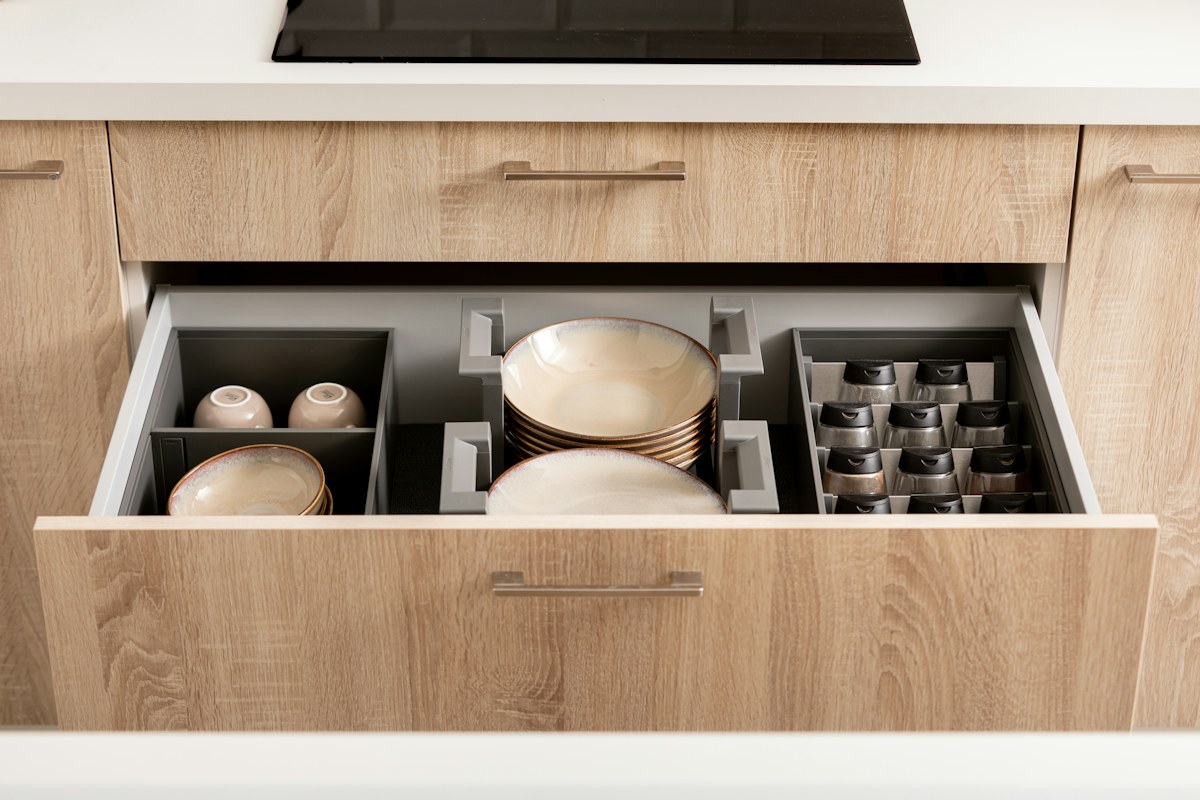
Use small trays or boxes you already have if they are clean, dry, and suitable for the drawer. Choose pieces that fit with their contents and stay stable as you open and close it. Place the first group near the front. Put the next tray beside it with enough room to lift both containers out for cleaning. Test any liner or divider against the drawer finish and follow its instructions. A few days with movable containers can show you which widths you actually need before you buy a single large insert.
If the trays slide, move them against an edge or choose a size that leaves less travel. Leave a little clearance to lift an item out comfortably. Tight packing can stop the trays from moving and make them hard to clean. Use a removable nonslip liner only if the material is suitable for the cabinet and kitchen use. Skip anything that will trap dampness beneath it. The arrangement should handle the pace at which you really open the drawer, including a busy meal when you are thinking about food rather than storage.
Work out how to store the awkward pieces
Lay a long utensil in the place where it seems to fit. Watch its highest point when it is lying on its side and when the drawer moves. An angled handle may settle into a deeper space when the utensil faces the other way. If a tool must lie diagonally across several groups, give it a narrow dedicated section or move it to another useful home. A long object can make several small groups harder to reach without using much of the drawer's volume.
A part that comes loose can also make the drawer troublesome. Put a detachable accessory in the same small container as its tool if the instructions allow. Keep food-contact items clean and dry before putting them away. If one group contains things that can catch on one another, lower the stack or set them side by side. See whether you can get the tool out without holding three others down. A good arrangement lets the most awkward piece leave the drawer as easily as the smallest spoon.
Test it twice in a normal week
Prepare an ordinary meal using the drawer. Notice whether you have to open it fully for something you use several times, or whether you keep setting a tool on the counter because its place is difficult to reach. After the meal, unload or dry the tools as usual. If the tray is confusing at that point, the compartments may be too similar or too narrow. Move the troublesome item before buying another container. Sometimes a small group works better with an open place than with an exact outline for each handle.
Check what changed when somebody else used the drawer. If they put the same two objects in a different place, ask which group made sense to them. A label can help with a general group such as measuring tools. Labels become harder to maintain if each new utensil creates another exception. Keep the arrangement broad enough to take a replacement tool of a slightly different shape. A drawer may serve the same job for years while the tools inside it change a little each season.
Try the arrangement from a clean-dishes basket
When several utensils come back at once, set the basket where you normally put it and reach from there. A group can be easy to see while the drawer is empty and easy to miss when the nearest tray is full of clean spoons. Arrange the compartments so the objects you return most often are visible without moving another tray. Put occasional accessories where they remain available without competing for the first space your hand reaches.
Think about which tools really need a separate container. A spoon rest or pair of matching clips might be easier to store on a wide flat part of the drawer. A small sieve needs a place where its handle and rim can settle without pressing on more fragile items. Test one loose group and one contained group during the same load of clean dishes. If the contained group is slower to put away and no easier to find, give that part of the drawer back to the tools that benefit from it. A tray earns its space by making one of those two moments simpler.
Keep the space you use for finding things
Leave enough visible bottom or tray surface to distinguish one group from the next. A drawer can look more complete with every gap filled, but finding and returning a spoon takes room. Save a small open place near the front if that is where a tool waits before you put it away. If the only remaining gap is long and thin, give it to one narrow object rather than using it as a home for every small loose item.
Check the arrangement after the next time you put away a full set of clean dishes. Open the drawer once more without carefully holding it level. If everything stays in a place you can recognize, the trial has given you a useful plan. Keep it with the trays you have if they do the job. If you choose an insert later, you now know which groups, dimensions, and clearances it has to preserve. The easiest drawer to use is the one that opens freely and gives you the right tool on the first reach.